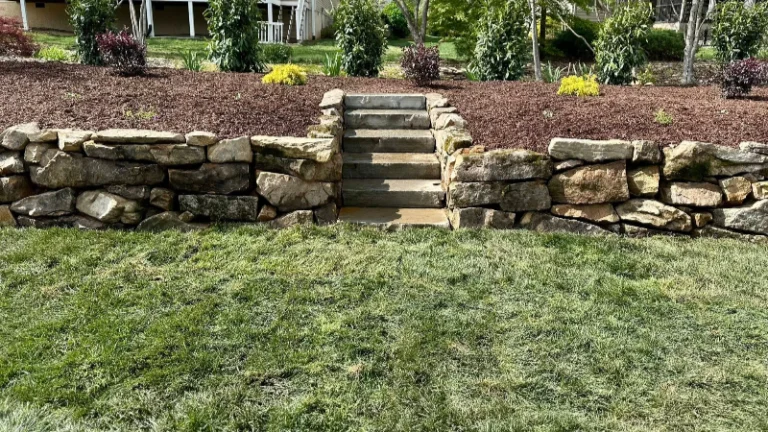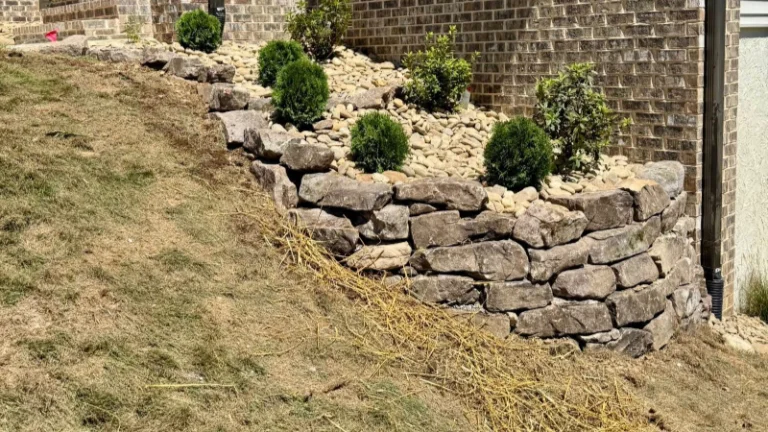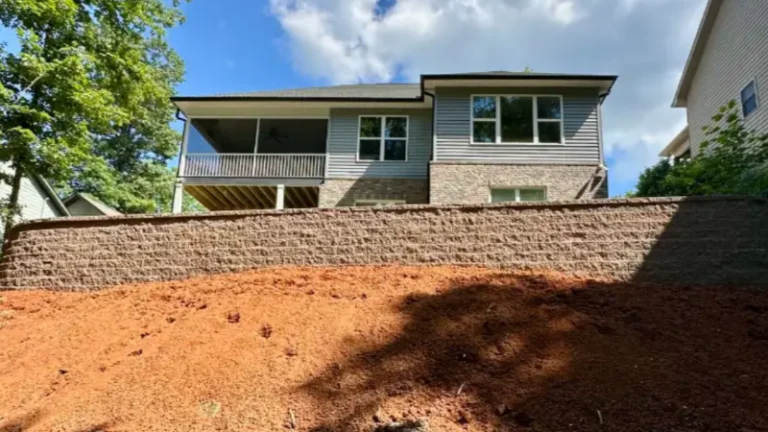
The Role of Geo-Grid Reinforcement in Tall Retaining Walls
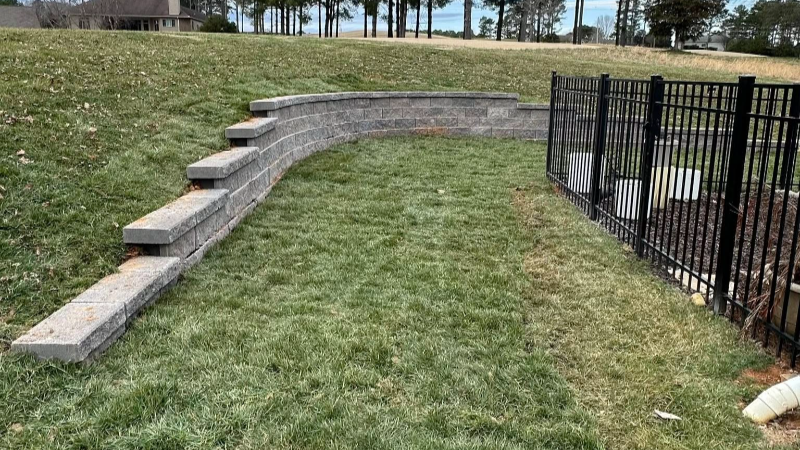
Retaining walls solve real problems on East Tennessee properties, they stabilize slopes, control erosion, and turn unusable grades into functional space. But once a wall gets taller, the rules change. A short garden wall can rely on weight and basic base prep. A tall wall needs a structural plan that accounts for soil pressure, water, and what is happening behind the face.
One of the most important parts of that plan is something most homeowners never see after the job is done, geo-grid reinforcement. At Property Docktors Landscaping, we use geo-grid on structural wall projects across Lenoir City, Loudon, Farragut, and surrounding communities when wall height, slope conditions, or loading demands require it. Below is a clear explanation of what geo-grid is, when it matters, and how it works together with proper drainage solutions to keep tall retaining walls straight for decades.
What is geo-grid reinforcement?
Geo-grid is a high-strength synthetic mesh that gets installed in layers within the reinforced soil zone behind a retaining wall. It is not decorative, and it is not a “nice to have.” It is engineered reinforcement designed to add tensile strength to soil, which is something soil does not have naturally.
A simple way to think about it is this. Soil is great at handling compression, but poor at resisting pulling forces. A tall retaining wall needs resistance to those pulling forces because the soil behind it is constantly trying to move downhill and outward. Geo-grid layers tie the wall system into the backfill mass so the wall and soil act as one stabilized structure.
Instead of asking the wall face to resist all the lateral pressure on its own, geo-grid helps distribute that pressure deeper into the slope where it can be safely resisted by the reinforced soil mass.
Why geo-grid becomes essential as walls get taller
As a retaining wall gets higher, the forces behind it increase dramatically. The load is not just the “weight of dirt.” It includes the effects of water saturation, slope angle, soil type, surface loading, and seasonal movement. In areas around Lenoir City, heavy rain events and clay-heavy soils can amplify those forces, especially when water management is not handled correctly.
A tall wall that is not reinforced may still look fine at first. The failure risk usually shows up later, after wet seasons, freeze-thaw cycles, or a period of soil saturation. By the time you see bulging or leaning, the structural problem is often already advanced.
Common challenges with taller retaining walls
When a wall pushes past a basic landscape feature and becomes a true structural element, these problems become more likely:
-
- Higher lateral soil pressure
The taller the wall, the more pressure the retained soil exerts against the face, especially when the backfill is wet and heavy. - Hydrostatic pressure during storms
Water trapped behind a wall adds weight and outward force. Even strong block systems can shift if water is allowed to build up in the backfill zone. - Movement from slope and soil conditions
Steep lots and variable soils can cause gradual settlement and shifting. If the wall is not reinforced, small movements compound over time. - Added loads from patios, driveways, or structures
If the wall supports a patio, vehicle area, outdoor living feature, or even a future expansion, the design needs to account for that additional load from day one.
- Higher lateral soil pressure
How geo-grid solves these problems
Geo-grid reinforcement works by creating a reinforced zone behind the retaining wall. Each layer of geo-grid is sandwiched between compacted backfill lifts. As the soil tries to move, the geo-grid resists that movement and spreads the load across a larger area.
The benefits are practical and measurable:
-
- The wall face stays plumb because the reinforced soil zone shares the load
- The system resists settlement and deformation better over time
- Taller walls can be built safely without relying on excessive wall thickness or “overbuilding”
- Performance improves on wet sites, steep slopes, and properties where drainage needs special attention
Geo-grid is not a replacement for drainage. It works with drainage. If a wall is reinforced but water is still trapped behind it, the wall can still fail. That is why our structural wall builds always include a drainage plan, not just reinforcement.
How geo-grid is installed in a retaining wall system
At Property Docktors Landscaping, geo-grid installation is not a guess-and-check process. It is installed based on wall height, site conditions, and manufacturer requirements. The goal is consistent, a stable base, properly tensioned reinforcement layers, and a backfill zone that drains efficiently.
Here is how geo-grid is typically incorporated into a structural wall build.
1. Site evaluation and excavation planning
-
- We evaluate slope, soil type, water flow patterns, and the intended use of the area above the wall.
- Excavation accounts for the wall footprint plus the reinforced zone behind it, not just the blocks themselves.
- If the project has known water issues, we plan drainage paths early and tie them into the wall design using drainage solutions.
2. Base preparation and the first courses of block
-
- A retaining wall is only as stable as its base. We build a compacted aggregate base designed for long-term support.
- The first course is set level and aligned precisely, because any error at the bottom is amplified as the wall gets taller.
3. Laying the first geo-grid layer
-
- After the initial courses are installed, geo-grid is placed perpendicular to the wall face and extended back into the reinforced zone.
- The grid is cut to fit the wall layout and positioned so it locks into the wall system as designed.
- Length and spacing are determined by the project requirements, not by a one-size rule.
4. Backfilling with clean material and compacting in lifts
-
- We backfill over geo-grid using clean, well-compacting material placed in controlled lifts.
- Each lift is compacted properly to keep the system tight and to ensure the geo-grid stays engaged and tensioned.
5. Repeating layers as the wall rises
-
- The wall continues upward in courses, and geo-grid layers are added at the specified intervals.
- On taller walls, reinforcement is commonly installed multiple times through the wall height to build a stable reinforced zone.
- This is also the stage where we confirm alignment, drainage placement, and compaction quality continuously.
6. Drainage integration and finishing details
-
- Structural reinforcement only works long-term if water is managed. We integrate drainage components such as clean stone backfill zones, filter fabric, and a collection method to move water away from the wall.
- Finishing details like cap units, grading at the top, and landscaping transitions are designed to keep surface water from dumping behind the wall during storms.
When homeowners want to see how a wall will affect the rest of the yard, our landscape design process and Landscape Visualizer help plan the wall, patio grades, steps, and planting areas as one complete layout instead of a series of disconnected decisions.
Mini case study: Reinforcing a steep backyard wall in Farragut
A homeowner in Farragut needed to stabilize a steep backyard slope that limited usable space and directed runoff toward the lower portion of the yard. The plan called for a wall height that required a structural approach, not a basic landscape wall.
We excavated the reinforced zone, installed the wall base correctly, and incorporated multiple geo-grid layers tied into properly compacted backfill lifts. We also integrated drainage behind the wall so water would not build pressure during heavy rain. The finished wall created a level area for outdoor use, improved slope stability, and reduced the long-term risk of movement that often shows up on steep sites.
When should geo-grid be part of your retaining wall?
Not every wall requires reinforcement, but when it does, it should not be optional. Geo-grid is most often needed when height, slope conditions, and loading demands exceed what an unreinforced wall can safely handle.
Geo-grid is commonly required when:
-
- The wall height crosses structural thresholds
As walls get taller, the design needs to transition from basic installation methods to a reinforced system built for long-term stability. - The wall supports a patio, driveway, or outdoor living feature
If you are planning an outdoor kitchen, patio expansion, or other improvements above the wall, the wall must be designed for that load from the beginning. - The site has steep grades or unstable soils
Properties with slope pressure, clay-heavy soils, or previous movement need reinforcement to reduce settlement risk and wall deformation. - There is a history of wall failure or water issues
If a previous wall leaned, bulged, or washed out, the new plan typically needs both reinforcement and a better drainage strategy. - You want a long-life solution, not a short-term fix
A properly reinforced wall is an investment in stability and property value, especially for homeowners planning to stay long-term.
- The wall height crosses structural thresholds
If you are budgeting for a retaining wall project, it helps to start with realistic expectations. Our pricing resources are built for that:
-
- Hardscape Pricing Guide for structural walls and hardscape build considerations
- Landscape Pricing Guide for grading, drainage, and landscape finishing work around the wall
Proudly serving East Tennessee with structural retaining wall construction
Property Docktors Landscaping builds retaining walls with drainage planning and geo-grid reinforcement throughout:
-
- Lenoir City
- Loudon
- Farragut
- Knoxville
- Tellico Village
- Rarity Bay
- Kahite
- Kingston
- And surrounding Loudon County communities
Get a retaining wall plan that is engineered, not guessed
If you are considering a taller retaining wall, the safest first step is a professional evaluation. Reinforcement, drainage, and layout decisions should be made before the first shovel hits the ground. That is how you avoid the common issues that lead to leaning walls, cracked faces, and expensive rebuilds.
Property Docktors Landscaping will evaluate your slope, soil conditions, and drainage, then recommend a wall system designed for long-term performance. Request an estimate to schedule a consultation and get a retaining wall solution that is built right the first time.